
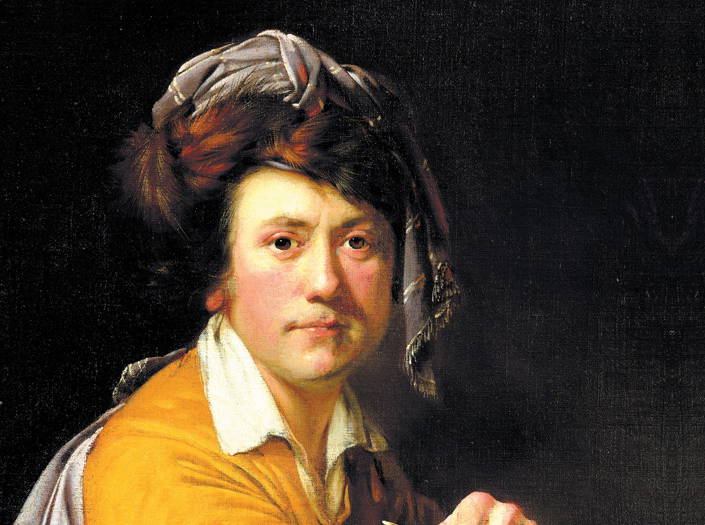
Joseph Wright is one such: he has always been a rather elusive figure. He left no diary, there are only about sixty surviving letters, many of which are rather mundane in their content: arrangements for appointments, checking on the details of pictures with a client and the like. Very little personal revelation has come down to us. He did keep a travel journal, fitfully, on his Italian tour and he paid great attention to his account book. This book was his to-do list, spreadsheet and record of income and expenses over nearly all of his career. It is messy and not very well kept.
So what are we left with in attempting to get at the sort of person he was? His niece, Hannah, wrote a short memoir about him, but this was fifty years after his death when she herself was in her nineties. It is only a faint echo of who he was. His wife, Ann, predeceased him and we know almost nothing about her. His children did not set anything down to record their life at home in the Wright household, and so there is a real dearth of first-hand material. William Bemrose, the eminent Derby printer, married Margaret Romana Simpson, a great grand-daughter of Joe’s in 1858. By this route he acquired many family papers which he assembled into a kind of family album which became the first attempt at a biography.
To re-imagine him, or to attempt to recreate him, or some semblance of him, therefore requires immersion in the work itself and some imaginative excursions into events which we know have happened and involved him, but for which we have precious direct evidence at all. It is possible to re-imagine his life and times, but impossible to verify much of it with absolute proof. In that way, Wright is rather like Shakespeare: he is there, as the work testifies, but at the same time, just beyond our grasp, shadowy, elusive.
Trying to create a version of him ~ a version which deployed all the known facts but which managed to shade in as many as possible of the missing elements, was the reasoning behind writing ‘Painting Faces’, the biographical novel which was published in October 2025. It arose out of a life-long interest in the man and his work, and in an easy familiarity with the collection housed in Derby Museum and Art Gallery. I first came across these pictures in the late 1950’s as a young boy and found them oddly compelling but quite incomprehensible. So many different subjects, such an odd mix of portraits, landscapes and strange events, often nocturnal scenes in smithies, old tombs, alchymist’s cellars, remote caves, a darkened drawing room with an orrery, or roaring volcanoes. What did it all mean? Who on earth was the man who could produce such variety?
There is a small but devoted literature on Wright. By and large these are monographs on particular aspects of his output and his biography is almost always passed over or dealt with in a pretty cursory way, all because of the difficulty already described. The academic perception of Wright has shifted greatly in the 230 years since his death in 1797. There was next to none from then until 1883 when the town held its first major exhibition of his work. Bemrose’s book was produced to support the exhibition and rally interest to the Wright cause and raise national appreciation of him. It was not until 1968 and the landmark Joseph Wright: Painter of Light monograph written by Benedict Nicolson that Wright’s star finally began its rise. In 1990 there was then a major retrospective exhibition at the Tate. In 2020 Matthew Crake produced the second landmark work on Wright’s oeuvre: Joseph Wright: Painter of Darkness. Consciously reversing the title of Nicolson’s book, Craske re-calibrated the public perception of Wright. Nicolson had promulgated the now rather clichéd view of Wright as a herald of the Enlightenment, the portrayer of the rise of scientific method over religious faith and so on. Craske, by comparison eschewed such motivational explanations of Wright’s art and instead drew attention to Wright’s personal melancholia, his tendency towards the gothic, to ‘night-thoughts’ and towards a preoccupation with death and mutability. In 2025 Derby Museums presented a unique exhibition of Wright’s works on paper. These focussed on the development of his skill and his style, illuminating his earliest development from boyish copies of prints, through apprenticeship exercises in Thomas Hudson’s studio in London and on to his self-portraits, Italian tour sketches and late fascination with landscape.
2026 will be Wright’s best year yet: there will be a compact exhibition at the National Gallery entitled ‘Wright of Derby: From the Shadows,’ which will look in detail at the great candlelight paintings from the mid 1760’s to 1773 when he married, went to Italy and thereafter developed a different style and range of composition.
‘Painting Faces’ falls handily amidst this burgeoning interest and appreciation of Joseph Wright. It attempts to do what none of the academic literature, the art criticism and the physical exhibitions can do ~ it attempts to re-create him in the round. Biographical novels are not usually thought of as having much of a contribution to make to the understanding of an artist’s life, motivations and aesthetic concerns. There have been exceptions ~ Irving Stone’s ‘Lust for Life’ on Van Gogh and ‘The Agony and the Ecstasy’ on Michelangelo were both hugely successful novels and movies and popularised their subjects in the 1960’s. More recently, Tracey Chevalier’s ‘Girl with a Pearl Earring’, did something similar for Vermeer, though this veered into fictionalised romance. ’Painting Faces’ attempts something larger: to re-create Joe with all the domestic and emotional events that colour anyone’s life. It also explores the effect of the close friendships he made amongst the other stellar talents that happened to live in Derby during his own time: John Whitehurst and Erasmus Darwin being prime examples, though there are others too. And then there are the other artists he befriended ~ or failed to befriend. Not all of his friendships were in his interest as an artist. The art world is notoriously competitive and became even more so in his time as his career coincided with the emergence of that new phenomenon ~ the public art exhibition. Joe was keen to shine against even against the most elevated of competitors such as Gainsborough and Reynolds. He was an ambitious man: he badly wanted to win.
What follows here are 100 observations of Joseph Wright’s life and times. They are little flavourings of what lies in the novel in more detail and depth. I hope they tempt you to try the full experience.
